


Rolling Through Time: The Invention That Changed the Sound of Banking
Before there were spreadsheets, scanners, and armored trucks, there was the clink of silver and the hiss of paper.
Inside America’s early banks, tellers spent their days stacking coins by hand, wrapping them in brown paper, folding the ends tight, and sealing them with glue or a metal clip. Each roll was a small masterpiece of patience and precision. And while it may seem mundane today, those humble paper cylinders once powered the machinery of everyday commerce. But by the dawn of the 20th century, America’s banks were growing faster than hands could keep up. That’s when a quiet mechanical revolution began the birth of the coin-wrapping machine.
The Human Hands Behind the First Rolls
In the late 180’s, banking was still a craft. Coins arrived from mints in heavy cloth bags, often stenciled with a bank’s name or a trusted teller’s initials. Every roll was counted, packed, and crimped by hand. Those early wrappers weren’t just storage, they were symbols of integrity. A neatly folded end told customers that every cent was accounted for. Some rolls even bore hand-stamped seals or embossed initials, the mark of a teller’s pride. Collectors today call these OBWs or Original Bank-Wrapped rolls and they remain among the most coveted finds in numismatics. Each one holds not just coins, but a tangible trace of the human touch that once defined American banking.
The Age of Invention: Charles S. Batdorf and the First Coin-Wrapping Machine
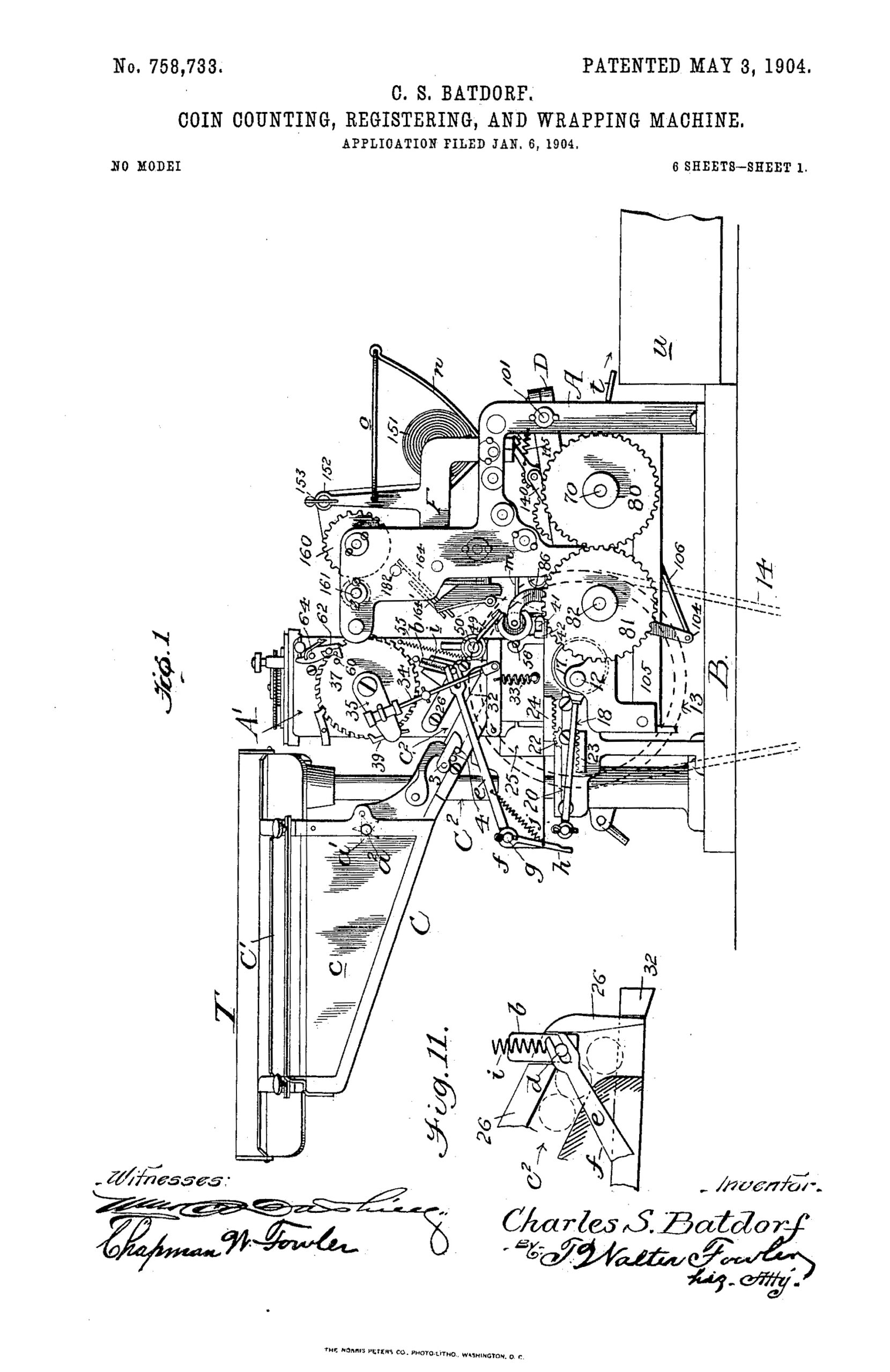
Progress came with a patent and a Brooklyn inventor named Charles S. Batdorf. On January 6, 1904, Batdorf filed U.S. Patent No. 758,733 for a “Coin-Counting, Registering, and Wrapping Machine.” Granted that May, it became the first fully integrated coin-wrapping machine in U.S. history. (View original patent https://patents.google.com/patent/US758733A/en)

Batdorf’s device did more than bunch coins. It:
- Counted each coin as it dropped from a hopper.
- Registered totals mechanically.
- Wrapped the stack in paper, and delivered a finished roll, ready for sealing.
It was elegant, efficient, and decades ahead of its time, a machine that could do in seconds what once took tellers hours. Three years later, on November 9, 1907, Erskine W. Jennings of Nashville filed his own patent (U.S. No. 930,291) for a “Coin-Wrapper.” His design, granted in 1909, focused on crimping the ends of rolls an important refinement, but not a complete wrapping solution. (View original patent https://patents.google.com/patent/US930291A/en)

In short:
- James Rice (1901) invented the coin buncher.
- Charles S. Batdorf (1904) invented the coin-counting, registering, and wrapping machine.
- Erskine W. Jennings (1909) perfected mechanical crimping.
Together, they set the foundation for every coin-wrapping system used in banks and mints ever since.
The March Toward Mechanization
Batdorf’s work lit the fuse. By the 1910s, innovators across the country were refining his concept, adding power drives, crimping dies, and counting gears. Companies like the Brandt Automatic Cashier Company (Wisconsin) and later Klopp Manufacturing (Ohio) carried the torch. By the 1930s, Klopp’s Model C could sort, count, and crimp coins with near-perfect precision. Brandt’s systems became legendary in banks and post offices, earning the nickname “the IBM of cash.” By mid-century, the sound of human fingers folding paper gave way to the steady hum of motors and gears, the heartbeat of modern banking.
The Science of the Seal
If you’ve ever held an old roll of coins with its perfect, flared paper ends, you’ve seen a miniature engineering marvel. Early crimpers used friction plates and tapered dies to curl the paper snugly around stacked coins, pressing it tight without tearing. For banks, those crimped ends were more than packaging, they were a guarantee. For collectors today, they’re a forensic signature. A perfectly symmetrical flare can reveal not just the coins inside, but the era and type of machine that sealed them.
Legacy of a Quiet Revolution
The first coin-wrapping machines didn’t just save labor, they standardized trust. They transformed banking from an art of hand-counting into a science of precision and consistency. Yet these machines also speak to something timelessly human: the drive to refine, perfect, and make work beautiful. A few of those early cast-iron devices survive today, their brass gears frozen mid-spin, relics of an age when progress was measured one crimp at a time. Collectors and historians treasure them not just as tools, but as symbols of progress, the mechanical heartbeat that once rolled through every bank vault in America.
At VintageBanker.com, we preserve the tools, patents, and stories that built our nation’s financial heritage,
from the first hand-folded coin rolls to the ingenious machines that turned simple change into a work of industrial art.