Shop


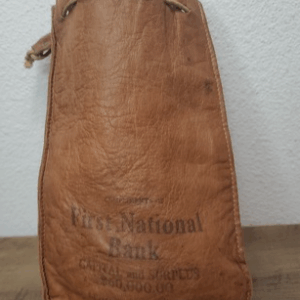
“Time is Money” Canvas Bank Deposit Bag – The First National Bank & Trust Company, USA (1940’s–1960’s)
Description
CAT ID: VB-TIM-USA-1940s-001
A mid-20th century canvas bank money bag featuring the slogan “Time is Money” and a generic bank name/address. Such cloth drawstring bags were commonly used by banks for coin and currency deposits and promotions.
Era and Style of the “Time is Money” Bag
This type of canvas drawstring money bag likely dates to the mid-20th century (circa 1930’s-1960’s). During that period, especially after the establishment of federal deposit insurance in the 1930’s, banks often ordered heavy-duty canvas bags with drawstrings, printed with their name and city (vintagebanker.net). These bags were symbols of trust and stability in the post-Depression era, used to securely transport coins/currency. By the 1950’s, it was common for banks to personalize such bags with logos or slogans as a form of advertising (afinecollection.wordpress.com). The slogan “Time is Money” on this bag reflects a popular proverb long associated with banking efficiency and thrift. For example, a 1913 newspaper ad for a First National Bank invoked “time is money” to promote its services (cdnc.ucr.edu), and some banks even placed “Time Is Money” on building clocks or signs as early as the late 19th century (facebook.com). This particular bag’s plain canvas, simple block lettering, and proverb slogan suggest a mid-century promotional style, before plastic or zippered bank bags became prevalent in the 1970’s. (Indeed, by the 1970’s banks were shifting to zippered nylon or vinyl pouches, and a Bank of America canvas bag from that era was identified by a dated logo (worthpoint.com).) So, the likely production era is around the 1940’s-1960’s, when canvas drawstring deposit bags with printed slogans were in wide use.
Common Uses in Banking History
Cloth drawstring bank bags like this served practical roles in day-to-day banking. Banks routinely issued canvas deposit bags to commercial customers and depositors from the 1930’s through the 1960’sfacebook.com. A merchant could place the day’s cash, coin rolls, or checks into the bag, pull the drawstring, and bring it to the bank for deposit (or drop it in the bank’s night deposit box). Unlike today’s locking courier bags, these older sacks relied on sturdy canvas and a cinched cord for security. Many were marked with the bank’s name and location to ensure they were returned to the right institution (vintagebanker.net). Besides deposits, banks also used such bags internally to organize coin shipments or store currency. However, banks quickly recognized these bags also had marketing value, a printed slogan or community message on a bag turned a mundane item into advertising. It was not unusual for a bank to include its motto or an anniversary tagline on the bag (for example, one 1950s bag from Maryland proudly read “Over FIFTY YEARS of Banking Service” alongside the bank’s nameafinecollection.wordpress.com). The slogan “Time is Money” on this bag was likely intended to remind customers that saving time and saving money go hand-in-hand, reinforcing the idea that using the bank’s services efficiently could “save” both time and funds. In essence, these bags were functional giveaways or tools that also spread the bank’s message each time a customer carried one.
Typical Manufacturers and Design Features
Several specialized manufacturers supplied banks with canvas money bags and often left subtle identifiers. One prominent maker was A. Rifkin Co., a Pennsylvania-based company (est. 1890’s) that produced bank bags and still operates today (afinecollection.wordpress.com). In fact, a very similar 1950’s deposit bag (for Farmers Banking & Trust Co. in MD) is noted to have been “manufactured by Rifkin & Co.”(afinecollection.wordpress.com). Such bags were usually made of heavy canvas or duck cloth, sometimes with metal grommets at the drawstring holes for durability (vintagebanker.net). They often had cotton cords with plastic or metal end tabs – the Rifkin bags, for example, used branded plastic end caps with an “R” (afinecollection.wordpress.com). Manufacturers would customize the print for each client bank, but they also sometimes included a reorder code or maker’s mark inconspicuously. For instance, some bags had a small line of text with a code and P.O. Box (likely the printer’s address or catalog code) printed on them, museum collections note examples like “Code 6710 P.O. Box 76368” on a Bank of America bag from the 1970’s, indicating the supplier’s reference number (worthpoint.com). Overall, these bags were built to be reusable and sturdy, capable of holding heavy coins, which is why many survive in vintage condition. Companies like Rifkin, and other bank supply firms, mass-produced them for banks nationwide. It’s likely this “Time is Money” bag was ordered through such a supplier’s catalog. The generic slogan and design could have been part of a stock design that banks could adopt with their own name printed (hence the same slogan appearing on multiple banks’ bags, like one from Wilber National Bank in New York (picclick.com)). In short, typical manufacturers were bank supply and canvas goods companies that specialized in secure bags, and they offered customizable templates to any bank, which leads directly to the “Your City, USA” labeling on this example.
“Your City, USA” as a Placeholder
The inscription “The First National Bank & Trust Company, Your City, U.S.A.” is a strong clue that this bag was made as a generic sample or promotional item rather than for a specific bank. In industry practice, phrases like “Your City, USA” are used as placeholders on sample products, order forms, or advertising mock-ups. For example, banking forms and checks in catalogs often showed a fictitious address such as “123 Main Street, Your City, U.S.A. 00000” to illustrate customization (fraser.stlouisfed.org). In a 1969 issue of Northwestern Banker magazine, a demonstration check is addressed to “YOUR CITY, U.S.A.” – underscoring that it’s a stand-in for any town (fraser.stlouisfed.org). Likewise, this bag’s text was almost certainly meant to be replaced with the actual city and possibly the bank’s name for real orders. The fact that it literally says “Your City” suggests it may have been a sample bag given to bank executives or shown at trade shows, or perhaps a prototype used in a photo shoot for a supplier’s catalog. No actual bank would list its city as “Your City, USA,” so the only reason to print that on the bag is to genericize it. It’s analogous to the phrase “Your Name Here” on sample personalized items. Therefore, if you have this exact bag with “Your City, U.S.A.” on it, it’s quite likely a promotional sample that was never issued by a specific bank. This also implies the bag’s slogan design (“Time is Money”) was part of a ready-made template that any First National Bank & Trust could adopt by ordering from the manufacturer with their city name filled in.
The “First National Bank & Trust Company” Naming Convention
“The First National Bank & Trust Company” in the bag’s label does not refer to one single bank, but rather is a generic wording capturing a very common bank name format in the U.S. Many communities (especially mid-century) had a “First National Bank,” and if that bank later added trust services, it often appended “& Trust Company” to its name. For instance, in Chickasha, Oklahoma, the local First National Bank added a trust department in 1965 and accordingly expanded its name to First National Bank & Trust Co. (bankfnbt.com). Dozens of banks across the country went through similar transitions, especially from the 1930’s-1960’s as offering trust services became a mark of a full-service bank. In fact, “First National Bank & Trust Company” was so ubiquitous a naming structure that it became almost a generic term for a hometown bank. The makers of this bag likely chose that phrasing to maximize its relevance – any bank with that name could imagine their own name on the bag. It’s also worth noting that the phrase “First National Bank & Trust Company” had broad appeal: by mid-century it evoked an image of a longstanding, federally chartered bank with trust powers (conveying strength and reliability). Using it in a sample was a safe choice, as it wouldn’t inadvertently point to a real institution in a different city. Essentially, the bag’s creator picked a “model” bank name that was both commonplace and aspirational. This means the bag wasn’t made for a specific First National Bank & Trust, but rather for any bank that might bear that name, reinforcing that “Your City, U.S.A.” placeholder. In summary, the presence of that name is a template: it suggests that any First National Bank & Trust (from Your City) could order these bags with their actual city and state printed, alongside the ready-made “Time is Money” slogan.
“Time is Money” – History of the Slogan in Bank Advertising
The proverb “Time is Money,” famously attributed to Benjamin Franklin, has been embraced by the financial world for well over a century. Banks and financial institutions frequently used this phrase in their marketing to emphasize efficiency, prompt service, and the value of saving. For example, as early as 1913, a First National Bank advertisement explicitly reminded readers that “time is money” when encouraging them to let the bank handle time-consuming tasks (the ad read: “…time is money. The First National Bank will thus keep your books for you if you carry a fair balance with them.”(cdnc.ucr.edu)). The slogan was short, punchy, and instantly understood by customers, making it ideal for promotional items like calendars, clocks, and money bags. In some towns, the local bank even erected street clocks emblazoned with “Time is Money” on their faces or pedestals as a public advertisement and service (one historic First National Bank clock in Salt Lake City bore this motto) (facebook.com).
By the mid-20th century, “Time is Money” had become a banking cliché, which is likely why it appears on this canvas bag. It connotes that using the bank’s services will save customers time (and by extension, money). We see the slogan on other bank memorabilia from that era as well. Notably, a cast-iron still bank (coin bank) from the early 1900’s was made in the shape of a clock with the words “Time is Money” on its face, produced by the Arcade toy company (etsy.com). Later, in the 1950’s-60’s, at least one plaster promotional bank in the form of a clock was also titled “Time is Money” (liveauctioneers.com) likely given to customers to encourage saving coins. While these are not cloth bags, they illustrate how prevalent the phrase was in bank-related promotions. It’s possible that some banks ran specific marketing campaigns around the phrase (for example, a 1960s bank print-ad might carry a headline like “Time is Money – Save Both at First National Bank!”), but more often it was used generally by many institutions rather than a single coordinated national campaign. The bag in question probably piggybacks on that widespread recognition. In summary, “Time is Money” in the context of this bag is a nod to a long tradition of banking slogans, meant to remind customers that not wasting time is as important as not wasting money, and that the bank can help you save both.
Sources: Historical bank memorabilia and auction listings afinecollection.wordpress.comvintagebanker.netfacebook.com; banking industry publications and archives fraser.stlouisfed.orgfraser.stlouisfed.org; examples from bank history blogs and museum collections cdnc.ucr.edufacebook.com. The phrase “Time is Money” as used by banks is documented in early 20th-century ads cdnc.ucr.edu and seen on period artifacts etsy.com, underscoring the cultural and promotional significance behind this vintage bag’s design.