Shop
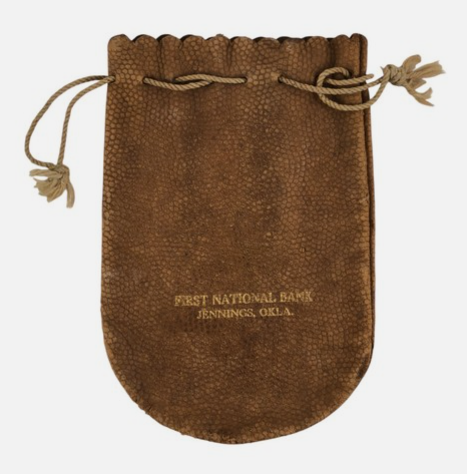
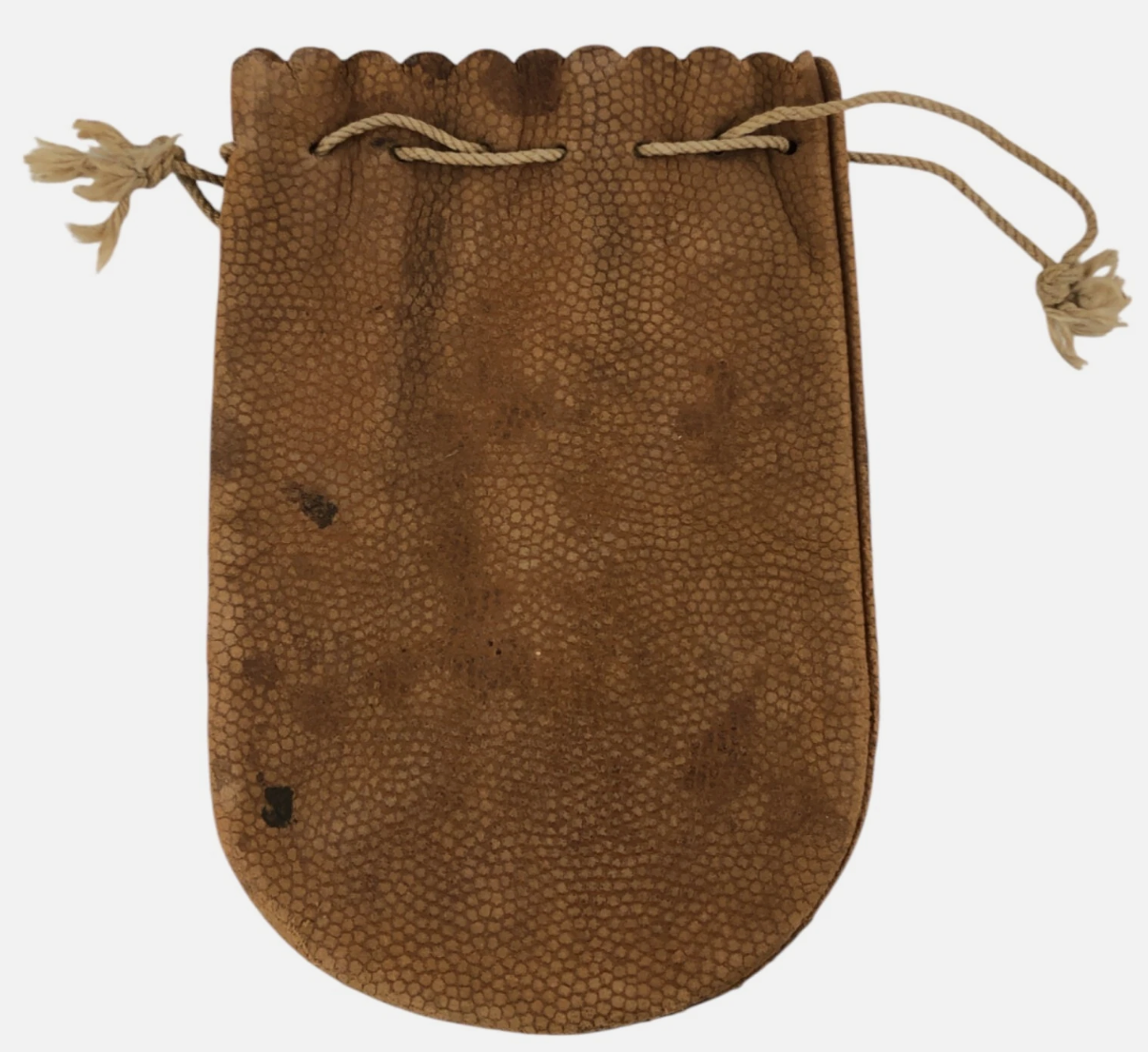
Vintage leather bank pouch from the First National Bank of Jennings, Oklahoma c. 1904–1928
$119.99
1 in stock
Description
Estimated Era: 1904-1928
SKU: VB-OK-JENNINGS-1904
First National Bank of Jennings, Oklahoma Leather Coin Pouch
This genuine leather drawstring coin pouch hails from the First National Bank of Jennings, Oklahoma, a financial institution that served the small boomtown during its oil rush years in the early 20th century. Embossed in gold with “FIRST NATIONAL BANK, JENNINGS, OKLA.”, the pouch exemplifies the refined craftsmanship and utilitarian design of early American banking accessories.
Constructed of finely textured brown leather with a scalloped top and jute drawstring closure, this piece measures approximately 5 by 7 inches. It remains in excellent vintage condition, showing only light wear consistent with age. Likely produced as a promotional item or customer gift, such pouches were used to store coins, notes, or receipts at a time when banking was still deeply personal and local.
The First National Bank of Jennings, chartered in 1904, financed many of the town’s early enterprises—from ranching and cotton to oil development—before closing during the Great Depression in 1933. Today, with Jennings’ population numbering under 300, artifacts from this period are increasingly rare, offering a tangible link to Oklahoma’s frontier banking history.
Condition: Excellent vintage condition; supple leather, clear gold lettering, intact drawstrings.
Origin: Verified Midwestern estate collection.
Category: Bank Bags & Coin Pouches
Archive ID: VB-OK-JENNINGS-1904
Authentic Craftsmanship
- Material: Full-grain cowhide, pebbled texture (classic 1900s tannery finish)
- Closure: Jute/hemp drawstring through hand-stitched eyelets
- Size: ~5″ × 7″ (closed) – perfect for silver dollars or folded greenbacks
- Patina: Rich tobacco-brown aging, supple yet sturdy
Circa 1904-1933
| Clue | Why It Dates the Pouch |
|---|---|
| Bank Name | “First National Bank” used 1904-1928; rebranded “First State Bank” 1928–1933 |
| Leather + Jute | Standard pre-1930s; canvas/plastic replaced leather post-Depression |
| Gold Embossing | Luxury touch phased out by 1930s cost-cutting |
| Jennings’ Lifespan | Bank failed March 18, 1933 pouch predates closure |
Best estimate: 1910-1925 the oil-boom sweet spot.
History of the First National Bank of Jennings
The bank behind your pouch was a cornerstone of Jennings’ early economy, reflecting the town’s rapid rise and fall as a classic Oklahoma boomtown. Here’s a timeline based on historical records:
| Year(s) | Key Event |
|---|---|
| 1893 | Jennings founded after the Cherokee Outlet Land Run (Sept. 16). Named possibly for developer George Jennings or outlaw Al Jennings; post office opens Nov. 14; early merchants set up shop. |
| 1901 | Bank of Jennings opens Nov. 25 as the town’s first financial institution. C.C. Burkholder (president) and J.A. Burkholder (vice president) lead it amid an agriculture-driven economy (cotton, grains, fruit). |
| 1903–1904 | Railways arrive (Arkansas Valley & Western, then Missouri, Kansas & Oklahoma lines), boosting trade. Bank re-charters as First National Bank of Jennings in 1904, gaining federal status for credibility and likely note issuance. Oil discovered nearby in 1904, sparking growth. |
| 1905–1918 | Town booms: saloons, hotels, cotton gins, and oil plants proliferate. Bank supports farmers, oil workers, and shipments of cattle/hogs outbound, coal inbound. Population hits ~800. |
| 1915 | Additional rail lines (Oil Belt Terminal, St. Louis & San Francisco extensions) connect Jennings to oil hubs like Oilton and Drumright, amplifying the bank’s role in energy financing. |
| 1920 | Oil boom peaks; population reaches ~910. Bank consolidates with Jennings State Bank to form Oklahoma State Bank of Jennings (fails in 1923 amid post-WWI volatility). |
| 1923–1933 | Great Depression hits: oil production craters, railways abandon lines (1933–34). Surviving First State Bank of Jennings (a re-charter of the original) fails March 18, 1933—part of ~9,000 U.S. bank closures that year. No successor bank emerges. |
| 10/5/1928 | According to the official listing: First National Bank of Jennings (charter #11791) converted to state charter and became First State Bank of Jennings. |
| 03/18/1933 | According to the official listing: First State Bank of Jennings failed. |
The bank’s closure mirrored Jennings’ decline: From a lively rail/oil hub to a quiet farm community. Today, Jennings (pop. ~280) is unincorporated, with residents commuting to Tulsa/Stillwater. No active bank remains, but the town’s legacy includes three churches, a weekly newspaper (Jennings News), and a K-8 school.