


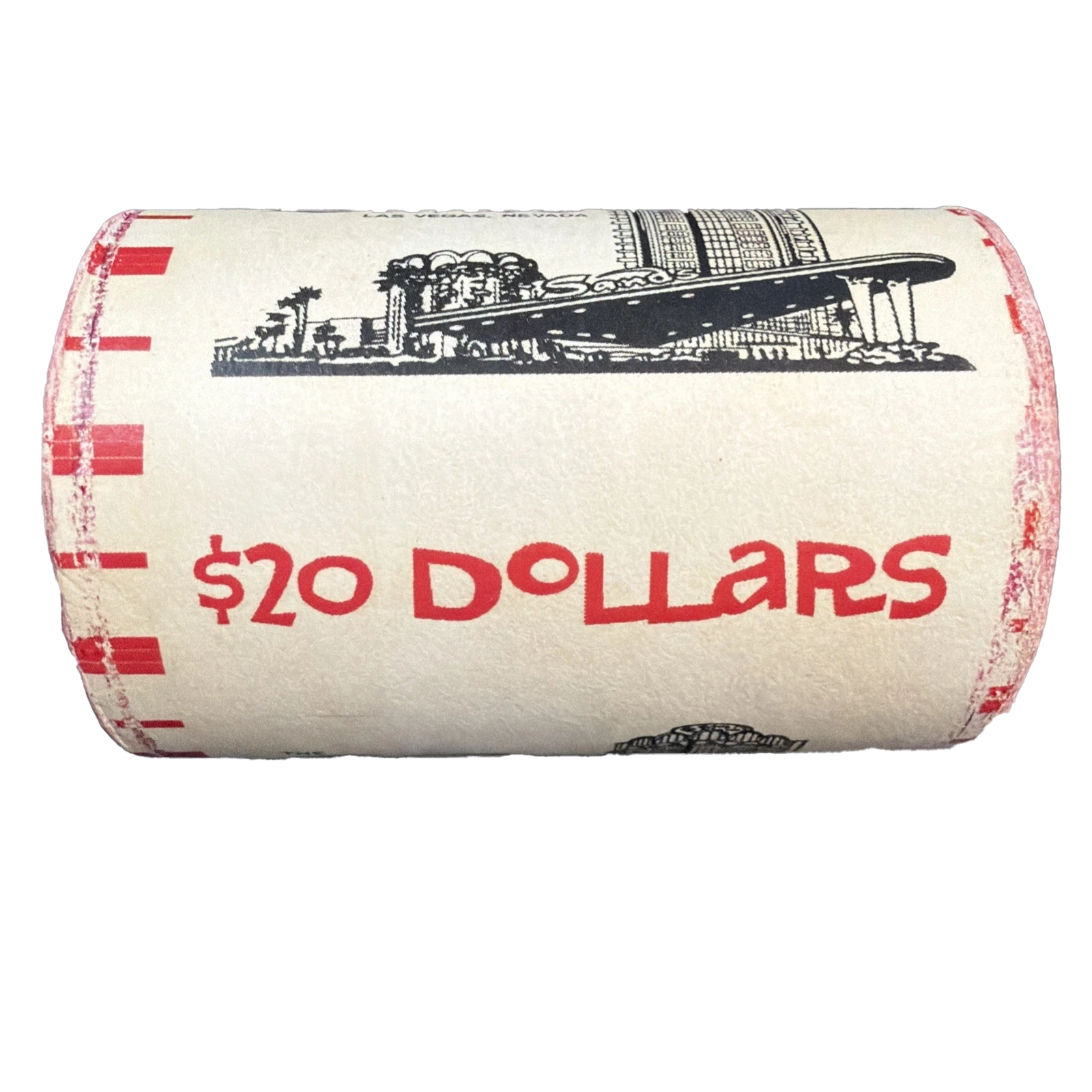
Stacked Silver and Slot Machines: The History and Value of Morgan Dollar Rolls from the Sands Casino
Historical Background of Silver Dollars in Casinos
From the 1940s through the early 1960s, Nevada casinos commonly used U.S. silver dollars (Morgan and Peace dollars) in slot machines, table games, and payouts. The Sands Hotel & Casino (opened 1952) was no exception, like other Vegas casinos, it kept large stocks of silver dollars (“cartwheels”) on hand for gaming operations[1][2]. In this era, patrons enjoyed the sound and feel of real silver dollars pouring out of slot machines, and casinos ordered huge quantities to meet demand (e.g. Reno casinos famously obtained 1.5 million silver dollars from the U.S. Treasury around 1964)[1][2]. However, when silver prices spiked in 1964 (making the $1 coins worth more as bullion), casinos faced a rapid outflow of their silver dollars, tourists and collectors began hoarding them as souvenirs or for silver value[3]. In response, Nevada regulators in 1965 approved the use of private $1 gaming tokens to replace silver dollars[4][5]. The Franklin Mint struck the first dollar tokens for casinos in mid-1965[4]. By the late 1960s, casino-branded tokens had largely supplanted silver dollars in circulation. In 1971 the Eisenhower “Ike” dollar (a large base-metal $1 coin) was introduced, and over 70% of Ike dollars ended up being used in casinos (casinos briefly preferred Ike coins over private tokens in the 1970s)[6]. After 1978, with Ike dollars discontinued, casinos returned fully to using house tokens and chips for the $1 denomination[7].
Bottom line: During the 1950s-early 1960s, Sands and other Vegas casinos did use Morgan and Peace silver dollars as gaming currency. It was common for casinos (or their bank suppliers) to roll $20 face-value batches of these dollars in paper wrappers for storage and handling. Multiple examples of vintage Las Vegas casino-branded coin rolls have surfaced, including rolls from the Sands, Flamingo, Stardust, Dunes, and other iconic casinos, indicating that such rolls were indeed used in that era as an internal way to bundle $20 in silver dollars (which equals 20 coins). These rolls were likely prepared by the casino cage or affiliated banks for convenience, rather than sold as retail souvenirs. The Sands Casino $20 roll in question, wrapped in Sands-branded paper, is consistent with known casino practices of the 1960’s, when $1 silver coins were still in active use on the casino floor.
Authenticity of the Sands Casino Roll and Coins

The paper wrapper on the item is critical to its authenticity. Originals typically bear the casino’s name (e.g. “SANDS – LAS VEGAS, NEVADA”), denomination ($20), and often a unique color or logo. Surviving examples show signs of age and wear, since they date back ~60 years. The presence of a Sands-branded wrapper strongly suggests an authentic artifact of the period, especially since a number of such wrappers (from Sands and other casinos) were discovered in an estate hoard and sold by coin dealers in recent years. For example, a 2022 auction listing highlighted a “Full Morgan/Peace Las Vegas Sands Casino $1 roll $20” still in its “old casino wrapper”, part of a large estate find. This confirms that Sands Casino did have custom $20 coin wrappers and that intact rolls have made it to the collector market.
As for the coins inside, all indications are that they are genuine Morgan (and/or Peace) silver dollars of mixed dates. The visible end coins in known rolls have been real U.S. silver dollars (e.g. an auction noted end dates 1890 and 1898 on a Sands roll). Coin dealers who handle these rolls routinely verify weight to ensure authenticity: a roll of 20 silver dollars should weigh about 534.6 grams if uncirculated (each Morgan weighs ~26.73 g), but slightly less if the coins are circulated (due to wear). In one Sands roll auction, the seller reported the roll’s weight was just under the full uncirculated weight, indicating the coins are circulated (and confirming they are indeed 20 real silver dollars, not fakes or plugs). Reputable sellers also often guarantee the coins’ genuineness. In short, the visible Morgan’s appear authentic, and the scenario (20 mixed-date silver dollars in a 1960s Sands wrapper) aligns with known history.
Numismatically, there’s nothing implausible, the dates could be anything from 1878-1935 (the span of Morgan and Peace dollar coinage) and typically include common, circulated coins. It’s worth noting that during casino use, rare dates or mintmarks were not cherry-picked. In fact, some casinos defaced the dates on their silver dollars (by sandblasting or grinding) specifically to discourage employees or patrons from swapping out collectible coins. Harrah’s casino in Reno famously sandblasted thousands of silver dollars (e.g. 1889-O Morgan’s) to make them look less collectible, though people still kept them as souvenirs. So, finding very worn coins or even ones with abraded dates in such a roll would not be surprising. Overall, an unopened Sands roll is recognized among both coin collectors and casino memorabilia enthusiasts as a piece of Vegas history, essentially a time capsule of circulated silver dollars from the casino era.
Collector Value: Unopened vs. Opened
Unopened (intact) casino rolls like the Sands example often command a premium over the raw silver value of the coins, because of their novelty, historical cachet, and the “unsearched” mystique. Collectors are buying not just 20 silver dollars, but the story, the idea that these coins might have sat in the Sands’ vault or cashier cage since the 1960s. Recent sales give a sense of market value: the 2022 auction of a Sands $20 roll sold for about $600 (hammer price). At that time the silver content and common-date Morgan dollar market value likely totaled roughly $500-$550, so the intact roll carried a modest premium. In late 2025, an eBay listing for a similar “Full Morgan/Peace Dollar Old Sands Casino Wrapper – 20 Silver Dollars” drew multiple bids into the $700+ range, again indicating that collectors will pay extra for the original wrapping and the chance (however slim) of a surprise rare coin. By contrast, if one were to open the roll, the value would largely depend on the individual coins inside. Typically, these rolls have 20 circulated Morgan and Peace dollars of common dates. Common-date Morgans in circulated grades (VG-XF) might be worth on the order of $25-$40 each in today’s market (depending on condition and silver spot price), so 20 coins might fetch roughly $500-$800 total if sold separately. There is a small additional value in the Sands wrapper itself as a collectible; an empty original wrapper from a famous casino could appeal to casino memorabilia collectors or coin roll collectors, though its value would be much lower than the coins (perhaps a few dollars to a niche buyer). The key is that once opened, the roll loses the “unknown treasure” factor and much of its crossover appeal to coin gamblers.
In summary, an unopened Sands casino roll is worth more as a unit – recent examples around $600-$800, whereas the opened roll’s value will equal the sum of its parts (usually not significantly above melt or common-coin value unless a rare date or high-grade coin is unexpectedly inside). Notably, the chance of finding a rare Carson City Morgan or key date in such a roll is low. Sellers and expert collectors caution that while “better dates/mint marks & conditions may be found,” they “should not be expected.” In the 2022 estate hoard, for instance, no extraordinary rarities were reported; the packaging itself was the main draw.
Signs of Reproduction or Tampering (“Shotgun Roll” Scams)
When evaluating a casino-branded roll like this, one must be alert to the possibility of aftermarket re-packaging. Original Sands rolls are scarce and intriguing, which unfortunately means some sellers try to fabricate “unsearched” rolls to exploit buyers. Common tactics include using a genuine old wrapper but refilling it with coins that have been cherry-picked, or even printing convincing replica wrappers. On online forums, seasoned coin hunters often warn that many of the so-called “original bank/casino rolls” on eBay are searched or staged. For example, one collector notes that a “common scam is [to] re-roll 20 Morgans and plunk attractive CC’s or rare year coins as an ender… then people will pay significantly more for the chance to score something rare in the middle. Which of course never happens.” In other words, be wary if both end coins are unusually high-grade or key dates (far nicer than one would expect from a random circulated roll) that’s a red flag of deliberate “window dressing.” In legitimate finds, the end coins tend to be random common dates or mixed Morgan/Peace dollars that reflect the overall circulated condition of the roll. Experienced collectors also point out that the U.S. Mint never issued Morgan dollars in rolls. Morgans were shipped from the Mint in bags, not paper rolls. Any rolled Morgan dollars were packaged by banks, casinos, or private parties after the fact. Thus, an “original roll” in this context means original to a bank/casino, not a sealed Mint product. This nuance is important: if a seller hypes a roll as “mint-sealed” or implies it was never touched since the 19th century, that is misleading, the most one can say is it might never have been searched since it was wrapped in the casino era.
How can you spot tampering? First, examine the wrapper’s condition closely. An authentic Sands wrapper from ~60 years ago should show some age (yellowing paper or faded print). If the paper looks modern or the printing is incorrect (font, logo placement not matching known examples), it could be a reproduction. Check the end crimps: original machine-wrapped or tight hand-wrapped rolls have fairly uniform, compactly folded ends. If one end looks re-crimped, excessively loose, or the paper shows tearing/retaping, someone may have opened and re-closed it. Some collectors will measure and weigh the roll: as mentioned, 20 circulated silver dollars usually weigh a bit under 534.6 g. If the weight is significantly off (too low could indicate fewer coins or non-silver coins; too high might indicate all uncirculated coins, suspicious for a circulated casino hoard), that’s a bad sign. In forum discussions, skeptical veterans often assume “these are all searched already… trick is finding the old vintage wrappers themselves then we all can get rich.” In other words, the default assumption is that any roll offered in the open market has likely been inspected by someone, true “time-capsule” rolls straight from a casino vault are exceedingly rare now.
That said, the Sands roll you have could well be genuine,many are but prudence is advised. If the ends show relatively ordinary dates (e.g. 1880s Morgans with no mintmark) and the wrapper looks legitimately old, that leans toward authenticity. Coin auctioneers like Key Date Coins Inc. have sold numerous casino rolls, always with the caveat that “better dates…may be found but should not be expected”. They openly state they acquired a “huge estate hoard” of such rolls, implying these were already picked over to some extent (no one selling would leave a known rare coin inside). Thus, while the rolls are authentic artifacts, it’s safest to treat them as containing average circulated coins. Reproduction wrappers are less common than simply re-used originals, but they do exist (and modern “fantasy” products like “Old Vegas Casino Rolls” of Ike dollars are sold for nostalgia, those are clearly marketed as novelties, not as unopened 1960s rolls). In the numismatic community, unopened casino rolls are viewed as fun collectibles or gambling-like propositions, but not something to buy expecting a big jackpot coin.
Examples of Similar Items and Expert Insights
To put the Sands roll in context, collectors have documented several comparable items: for instance, a 1960s Stardust Casino $20 silver dollar roll and a Dunes Hotel $20 roll were noted in a price guide listing[8], and a mixed Morgan/Peace roll from the Flamingo casino was sold as well. These all follow the same pattern, a custom-printed wrapper with the casino’s name encasing 20 U.S. silver dollars. They tend to sell in the mid hundreds of dollars. The Sands roll mentioned earlier went for $600 at auction, while a Flamingo-branded roll (20 mixed silver dollars) sold in a similar range. Coin experts generally treat these as numismatic curiosities that straddle two collecting realms: coin collecting and casino memorabilia. A coin dealer will value the contents (20 silver dollars) and maybe a small premium for the intact original wrap, whereas a casino memorabilia collector values the wrapper and its link to a famous casino (the coins inside might be of secondary interest). In a 2015 Coin World article, dealer Rusty Goe emphasized how integral silver dollars were to the old casino experience, the sound of Morgans clinking was part of the allure[9]. That nostalgia factor is what current buyers are often paying for. Numismatic forums have multiple threads on these “casino rolls,” with seasoned collectors often voicing skepticism if someone claims to have found a rare date in one. As one commenter dryly put it regarding eBay rolls: “You paid too much for 20 very common Morgan dollars… stop acting like you have some private connection for original bank-wrapped rolls of uncirculated Morgans. Because you don’t.” The consensus is that unopened rolls should be enjoyed for their history, not as a retirement plan.
In conclusion, a Sands Las Vegas $20 Morgan dollar roll is a fascinating piece of 20th-century casino history. Such rolls were used by the Sands Casino (and others) to bundle silver dollars for gaming use. The coins visible on the ends are genuine Morgan silver dollars, and the roll format is recognized among collectors (though not a U.S. Mint-issued product). As a collectible, an intact Sands roll has value both as a numismatic grab bag and a Vegas memorabilia item often selling for a healthy premium when kept unopened. If opened, its value reverts to the actual coins and an empty wrapper, usually less than the intact value unless a lucky rare coin is discovered. When assessing these rolls, look for indications of tampering and approach any “unsearched” claims with caution. Confirmed examples at auction and discussions by experts reinforce that most contain circulated common-date dollars and that the wrapper’s authenticity is key. With realistic expectations, a sealed Sands casino roll is a rewarding collectible, a tangible link to the Rat Pack era of Las Vegas but its worth lies in history and novelty more than in any hidden treasure inside.
Sources: Historical data on casino use of silver dollars[3][5]; Coin World report on Harrah’s defaced dollars; Auction listings of Sands casino rolls; Collector forum insights on roll authenticity and scams; Eisenhower dollar usage statistics[6].
[1] [2] [9] Casino owner sandblasted silver dollars to remove collectibility
[3] [4] [5] [7] Anyone Know Where I Can Get Info on Casino Silver Dollars? – Collectors Universe
[6] Eisenhower dollar – Wikipedia
https://en.wikipedia.org/wiki/Eisenhower_dollar
[8] (3) MORGAN (1) PEACE Silver Dollars ** Lady Luck Casino …
https://www.worthpoint.com/worthopedia/morgan-peace-silver-dollars-lady-luck-3906098409